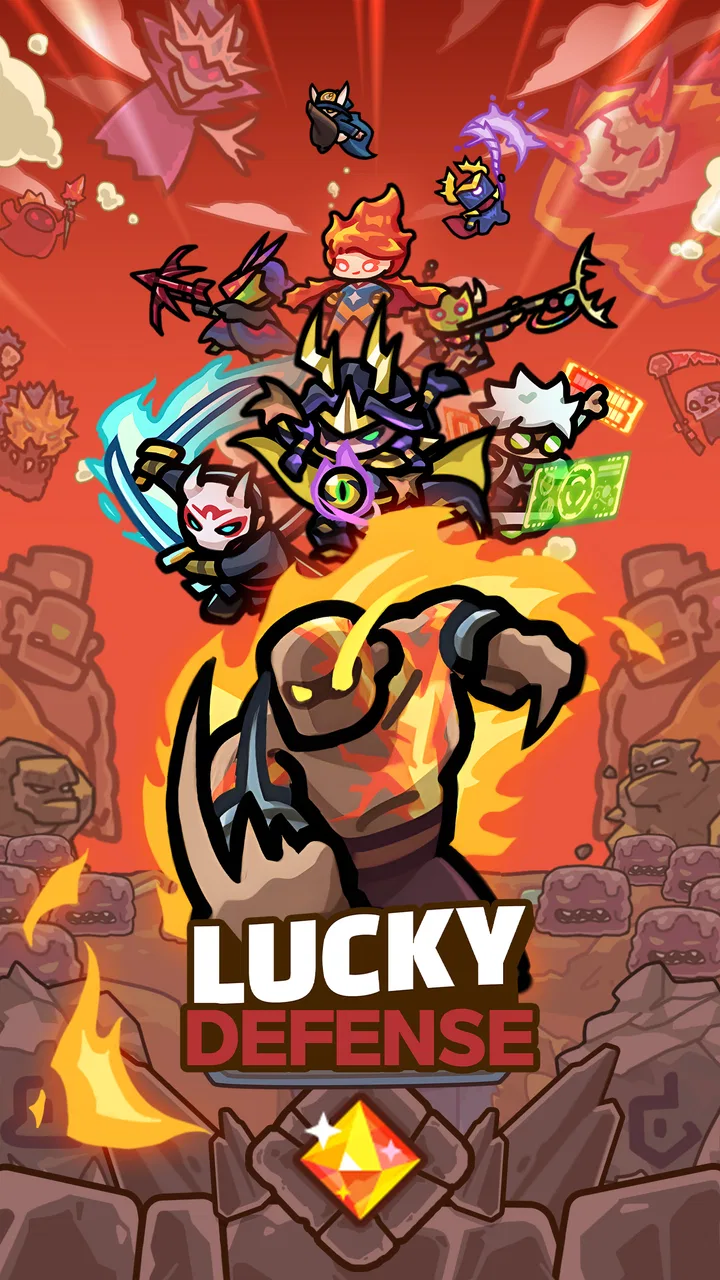
Lucky Defense
- 4.3
- Rating
- 5.00M
- Installs
- Free
- Price

 Analysis by App-foxy
I went into Lucky Defense expecting a lightweight tower defense game, and that is exactly where it works best: as a quick, repeatable mobile game built around making a placement, watching the battlefield react, collecting the result, and deciding whether to try again. It comes from 111% and sits in the casual game category, but it still asks you to pay attention. The action is simple to understand, while the value of each decision becomes clearer as a round develops.
The basic appeal is easy to feel during the first session. You place your defenses, enemies move through the route, attacks land, and the screen gives you immediate feedback about whether your setup is holding. When a wave goes well, the reward is not only progress; it is also the temptation to test a slightly different approach next time. That cycle makes the game comfortable for short breaks, yet it has enough decision-making to keep it from feeling like a completely passive time-killer.
Why the first move matters more than it seems
The opening action in a tower defense game often looks small, but it establishes the whole rhythm. In this one, I found myself thinking less about building a perfect arrangement immediately and more about creating a safe starting position. A defense that survives the early pressure gives me room to observe the battlefield, understand what is working, and prepare for the next threat instead of reacting in panic.
You May Also Like

 Blood Strike: 2.5 Anniversary
Blood Strike’s Loadouts Turn Every Drop Into a Tactical Gamble
A close look at Blood Strike’s custom loadouts: how fast access to signature weapons reshapes its battle royale rhythm, rewards preparation, and narrows the gap between fights.

 Pandora - Music & Podcasts
Pandora’s Music Is Easy to Start, but Harder to Recover
Pandora’s strength is its low-effort path from a seed to a station. Its weak spot is how much confidence it asks you to place in connection, setup, and quiet recovery.

 8 Ball Pool
 Is Built on Rivalries, Rematches, and Routine
A close look at the rivalries, rematches, shared routines, and unanswered safety questions that turn a quick pool match into a persistent mobile community.

 Samsung Music
’s Quiet Strength Is Playing What You Already Own
Its reach comes less from spectacle than from dependable access to a personal library. That simplicity is both the app’s strongest retention engine and its ceiling.

 AccuWeather: Weather Radar
AccuWeather Review: A Quick, Clear Forecast for Everyday Decisions
For everyday plans, the best forecast is the one you can understand quickly. AccuWeather makes rain timing, radar, and local conditions easy to act on, with a few trade-offs.

 Hill Climb Racing
Why Hill Climb Racing Still Turns Crashes Into One More Run
A tiny car, a bumpy hill and one more upgrade: Hill Climb Racing keeps resurfacing because its simple chaos makes every near-miss feel personal.
More From Our News Desk
View All News


That makes the game approachable for people who do not normally play strategy titles. You do not need to learn a large control scheme before beginning. The interaction is focused on the battlefield, and the casual presentation keeps the first few decisions from feeling intimidating. At the same time, the simplicity can be deceptive: placing something quickly is easy, but knowing when to strengthen an existing position or change your plan is where the game becomes more interesting.
I recommend resisting the urge to spend every available resource as soon as it appears. A common mistake is to treat each early reward as permission to build immediately. I had better results when I paused long enough to see where pressure was forming. That small delay turns the first action from a reflex into a choice, and it also makes later failures easier to understand.
The game is especially comfortable on a phone because the individual decisions do not require a long uninterrupted setup. I can start a session while waiting for an appointment, play through a short stretch, and put it down without needing to remember a complicated control sequence. That convenience is one of its strongest practical qualities. It feels designed for repeated visits rather than one long campaign sitting.
Learning the battlefield without overthinking it
My advice for a new player is to treat the first few rounds as observation rather than a test of skill. Watch which parts of the route become dangerous, notice how quickly a defense responds, and pay attention to the moment when a comfortable position starts to collapse. This approach gives the feedback more meaning. Instead of simply seeing that a round was lost, you can identify whether the problem was poor timing, an exposed section, or an arrangement that could not keep up.
That is also where the game separates itself from very basic casual alternatives. A simple matching game or endless runner usually gives you a direct action and an immediate score. Lucky Defense adds a layer between the action and the result. You make a setup, wait for it to operate, read the outcome, and then adjust. The delay is short enough to stay accessible, but long enough to make planning feel worthwhile.
There is a trade-off here. Players who want constant manual action may find the early phase slower than an arcade game. The fun comes from watching a decision play out, not from tapping continuously. If you prefer direct control over every second of a battle, a faster action game will probably feel more satisfying. This is better suited to someone who enjoys setting a plan and seeing whether the plan survives.
The free entry point helps with that experimentation. You can try the game without paying upfront, and the Everyone age rating makes it easy to recommend as a broadly accessible casual title. I still would not hand a device to a child without checking the purchase settings first, because the game includes optional in-app purchases ranging from $1.99 to $109.99 per item. The age rating describes the content, not a guarantee that every spending situation will suit every family.
The feedback rhythm keeps each wave readable
The strongest part of the experience is the feedback rhythm. I make a choice, the defenses respond, enemies advance, and the result becomes visible quickly. When the arrangement is working, the game creates a satisfying sense of control. When it is not, the pressure is clear enough that I can usually tell something needs to change before the situation becomes completely hopeless.
That rhythm is important because tower defense can easily become either too passive or too complicated. If the game handles all the interesting decisions for you, watching the screen loses its appeal. If it demands constant adjustment, it stops being a relaxed casual experience. Lucky Defense generally sits in the middle. It gives me time to read the result, but not so much time that every round feels automatic.
One useful habit is to judge a defense by how it behaves under pressure, not by how impressive it looks when the route is quiet. A setup can appear strong during an easy stretch and still fail once the flow becomes more demanding. I found it more useful to keep a mental note of which position was doing the real work and which position was merely benefiting from a calm moment.
Another practical tip is to avoid changing several things at once after a setback. If you move everything, you may survive the next attempt without learning why. Changing one important part of the arrangement gives the next round a clearer purpose. This is a small approach, but it makes the reset-and-retry loop feel less random and more like gradual improvement.
The game also benefits from short feedback windows. I do not need to wait through an elaborate explanation to understand whether a choice helped. That makes it easier to play casually, especially when I am not in the mood for a deep strategy session. The downside is that players looking for highly detailed tactical information may want more depth than this format provides. Its communication is practical and immediate rather than analytical.
Rewards are most useful when they lead to another experiment
Rewards in this kind of game work best when they encourage a new decision rather than simply marking the end of a round. Here, the satisfying part is seeing a successful defense turn into another opportunity to improve the setup. A good result gives me enough confidence to try a bolder arrangement, while a weaker result suggests a safer adjustment.
I like that this makes progress feel connected to play. The reward is not isolated from the battlefield; it feeds back into the next attempt. That connection is what keeps the game from becoming a string of unrelated screens. I finish one round with a clearer idea of what I want to test next, which is a stronger reason to continue than a generic progress bar alone.
There is also a psychological balance between luck and judgment. The title points toward chance, and the game’s casual identity supports a less rigid approach than a serious competitive strategy game. Still, I never felt that every outcome could be explained by luck alone. My choices affected the result, but the uncertainty made me willing to replay a situation instead of assuming that one failure settled the matter.
That combination will appeal to players who like a little unpredictability in their strategy games. It may frustrate anyone who wants complete control and a guaranteed path to success. If you need every result to be perfectly repeatable, the casual luck-driven flavor may feel less fair than a traditional tower defense game with highly transparent rules. For me, the uncertainty worked because the sessions are easy to restart and the consequences do not feel overwhelming.
I also found a useful distinction between a reward that helps immediately and one that encourages long-term learning. Immediate gains are exciting, but the more valuable reward is information: discovering that a certain placement is too slow, that a vulnerable section needs attention, or that saving a resource creates a better response later. That is the kind of progress that remains useful even when the next round does not go perfectly.
Why the reset makes failure easy to accept
The reset is central to the game’s appeal. A failed session does not feel like a long-term disaster; it feels like a prompt to try a different opening. Because the core interaction is straightforward, I can return to the battlefield quickly and apply one lesson while it is still fresh. That keeps frustration from building in the same way it can in a long, demanding strategy campaign.
This is where the game fits everyday use particularly well. Imagine having ten minutes before leaving for work. You can start a session, make a few decisions, see whether the defense holds, and stop after the attempt without committing to a large story or a lengthy multiplayer match. Later, when you have another spare moment, the reset gives you a clean reason to return: try the opening again, but protect the weak point earlier.
The same structure works for someone who plays while relaxing at home. A session can remain casual, but it does not have to be mindless. I can play while listening to music, yet I still have a reason to look up and reconsider the arrangement when the battlefield changes. That middle ground is more appealing to me than games that demand full concentration or games that barely require any attention.
However, the reset loop can become repetitive if you are not interested in experimenting. The game depends on your willingness to ask what could be different next time. If you repeat the same setup without reflecting on the result, the sessions may blur together. This is not the best choice for someone who wants a large narrative, constant new mechanics, or a strong sense of exploration between battles.
Another limitation is the potential pull of optional purchases. The game is free to start, which lowers the barrier to trying it, but the listed purchase range reaches from $1.99 to $109.99 per item. I would approach that system with a personal spending limit and avoid treating a difficult round as a reason to buy something immediately. The most satisfying part of the loop is learning the battlefield, and spending does not replace that learning.
Who will enjoy the loop, and who should choose something else
I would recommend this game to players who like casual strategy, short sessions, and the feeling of improving through small adjustments. It is a good fit if you enjoy watching a plan unfold and then deciding whether to keep, refine, or replace it. It also works for people who want a tower defense experience without committing to the heavier systems found in more elaborate strategy games.
It is less suitable for players who want a purely reflex-based experience. The important moments are not about tapping as fast as possible; they are about choosing a response and reading the result. Likewise, people who dislike chance in strategy games may prefer a more deterministic alternative where every failure can be traced to a precise tactical error.
Compared with a traditional tower defense title, this feels lighter and more immediately approachable. You can get into the action without spending a long time studying a large technology tree or a complicated interface. Compared with a minimalist idle defense game, it asks more from you because your setup matters and the battlefield provides a reason to pay attention. That middle position is its identity: accessible enough for casual play, but active enough to reward thought.
It is also worth considering the device requirements. The game supports Android devices running version 7.1 or later, so it is not restricted to only the newest phones. I would still expect the experience to depend on how comfortably your particular device handles modern mobile games, especially if you prefer playing for long periods. For a quick phone session, the modest entry requirement makes it easier to try than many newer releases.
My final take on the action-reward-reset cycle
After spending time with it, I see Lucky Defense as a game built around a clean question: can this arrangement survive, and what will I change when it does not? The first action is easy to understand, the feedback arrives quickly, the reward gives the next attempt a purpose, and the reset keeps failure from becoming a chore. That sequence is the reason another session begins.
The game has earned a 4.3 average from over 214 thousand ratings, with more than 5 million installs, which matches my impression that it has broad casual appeal. It launched on May 23, 2024, and version 2.0.11 is the current version I would look for when installing it. Those figures do not make the decision for you, but they do show that this is not an obscure experiment with no established audience.
My main caution is to keep expectations realistic. This is not a deep, story-heavy strategy game, and it will not satisfy everyone who wants total control or endless mechanical variety. Its strength is narrower and more practical: it turns tower defense into a series of readable experiments that fit naturally into spare moments.
If that sounds like the kind of game you would enjoy, the free download makes trying it straightforward. I would begin without buying anything, learn how the battlefield responds, and set a spending boundary before optional purchases become part of the routine. For short, repeatable tower defense sessions with a light strategic edge, it is an easy game to recommend.
FAQs for Lucky Defense
01What is Lucky Defense, and how does the gameplay work?
Lucky Defense is a casual tower-defense game in which you summon monsters, combine units, and build a team to stop waves of enemies. Its main appeal comes from random summon results, strategic positioning, and upgrading creatures during a match. Because luck influences which units appear, players need to adapt their strategy rather than relying on one fixed lineup.
02Is Lucky Defense free to download and play?
Lucky Defense can generally be downloaded for free on supported Android and iOS devices. The game may include optional in-app purchases for currency, upgrades, bundles, or other convenience items. You can usually make progress without paying, but progression and collection may feel slower if you avoid purchases. Check the store listing and your device settings before downloading.
03Does Lucky Defense require an internet connection?
An internet connection may be required for important features such as loading your account, receiving updates, synchronizing progress, watching advertisements, participating in events, or using online modes. Some parts of the game may work temporarily offline, but this should not be assumed for every session. A stable connection is recommended to prevent lost progress or interrupted rewards.
04Is Lucky Defense suitable for children and casual players?
Lucky Defense is relatively easy to understand because its basic objective is to defend against enemy waves, but the random summoning and upgrade systems add strategic depth. It can suit casual players who enjoy short matches and gradual progression. Parents should still review the age rating, advertisements, chat or social features, and optional purchases before allowing children to play.
05What should I know about progression, ads, and in-app purchases in Lucky Defense?
Progression in Lucky Defense typically involves collecting units, improving their abilities, completing missions, and earning rewards from regular play. Advertisements may offer optional bonuses, while in-app purchases can provide extra resources or accelerate development. The game is more enjoyable when purchases are treated as optional rather than necessary, so consider disabling buying features if the device is shared with children.
Pros
- Quick matches make it easy to play during short breaks.
- Tower combinations create satisfying strategy and replay value.
- Random rewards keep each run feeling different.
- Colorful visuals and playful effects make battles enjoyable.
- Progression systems give you reasons to return regularly.
Cons
- Later stages can feel heavily dependent on luck.
- Upgrade materials may take time to collect without spending.
- The battlefield can become visually cluttered during large waves.
- Some features may require watching frequent optional ads.
- Limited strategic control may frustrate players seeking deep tactics.

Lucky Defense
Gallery